Failed Medical Information System
Kun Yuan
Department of Computer
and Information Science
Brooklyn College,
City University of New York
Outline
Ø
Introduction
Ø
The causes and solutions
of the failed medical information system
Ø
Case study
Ø
Conclusion
Introduction
·
The area of medical
information systems have long been explored and studied since 1960’s in almost
all aspects of medical care. From integrated, continuing patient medical record
to software-aided medical devices, from computerized medical imaging and
pattern recognition to automated medical diagnosis, etc.
·
Medicine’s dirty
software secret is that it has wasted untold millions on failed software
projects.
·
Some health care
information systems (HCIS) do succeed, but the majority are likely to fail in
some way.
Three major reasons leading to Medical System Failure
1. Software related failure in medical device activated
by software faults
2. Failure caused by the large design ---- reality gaps
3. Caused by one of the human natures ---- Pride


1.
Software related failure in medical device activated
by software faults
a. The associated failures caused no death or injury and
recalled by their manufacturers from 1983 to 1997
b. Failure
Analysis
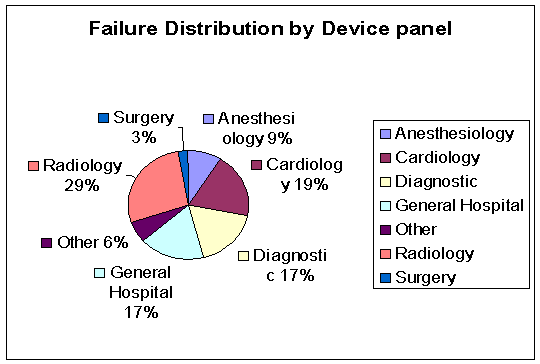
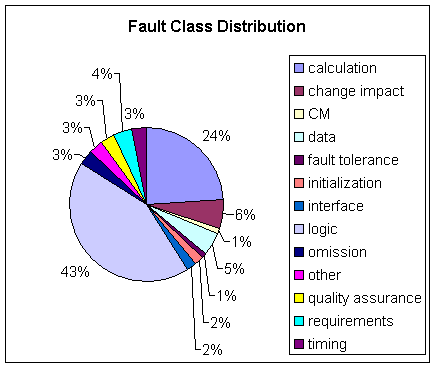
c. Prevention and detection of faults
Include
inspection as both a prevention and detection technique and use a variety of
other techniques to detect the problems and prevent them from happening again.
·
No Verification against original design specification
|
Prevention |
Detection |
|
Traceability analysis. Change impact analysis |
Inspection of proposed changes. Regression test |
·
Use of wrong master
program for the software revision
|
Prevention |
Detection |
|
Use of CM tools |
Verification of appropriate master program. CM manager inspects the versions |
d. lessons learned
d.
Lessons learned
·
Development &
maintenance
Complete
specification of requirements, Traceability of the development artifacts,
software config. Management,etc.
·
Assurance Practices
Formal
inspection meetings, Mental execution of potentially troublesome locations (e.g.,an
algorithm, a loop, an interface), use of simulation in complex situations,etc.
·
Testing
Stress
testing, regression testing, integration test, system test, etc.

2.
Failure caused by large design --- reality gaps
“The
critical issues in the implementation of these (HCIS) systems are social and
organizational, not solely technical”(Anderson 1997:89)
1) Dimensions of the Conception --- Reality Gap
(design conceptions vs. contextual realities)
‘
ITPOSMO’ model to study conception --- reality gaps
·
Information
·
Technology
·
Process
·
Objectives and values
·
Staffing and skills
·
Management and
structures
·
Other resourses: money
and time

2)
Archetypes of Health Care Information System Failure
·
Rationality --- reality
gaps
“Hard
rational model” vs. “Soft behavioral model”
ü Technical rationality
ü Managerial rationality
ü Medical rationality
·
Private --- public
sector gaps
·
Country gaps

3)
Lessons
learned
·
Assess the mismatch
along the seven main dimensions (ITPOSMO model)
·
Use gap closure
techniques for greater HCIS success
Ø Legitimizing
and mapping organizational reality
Ø Reality-supporting not rationality-imposing
applications
Ø Customization
to match realities

3.
Caused by one of the human natures ---- Pride
(Case Study)
Wessex
Regional Health Authority tried to computerize hundreds of hospitals at a time
when other health authorities were struggling to computerize a single
outpatient department --- £ 43 – 63 million failure
Here
pride refers to a belief among some computer managers that they should know it
all – and cannot easily admit when they don’t
Nobody
questioned the technology visionaries because the uninitiated felt unqualified
to challenge those who were assumed to know what they were doing
So
when something goes wrong, it was hidden to the public or even to the inside
till long after the failure was exposed
Conclusion
·
Technically, use of many
generally accepted quality practices, rather than use of a “silver bullet” is
significant towards reduction of system failures
·
Use effective techniques
to reduce conception-reality gap and other gaps
·
Computers rely for their
functioning on reason, but computer projects defy logic because of human
caprice
·
A successful HCIS will
be one that tends to match its environment in relation to technical, social and
organizational factors
References:
1.
Collins T., Bicknell D.
(1998) Crash – learning from the world’s
worst computer disasters, Simon & Schuster UK Ltd, 55-97.
2.
Anderson, J.G. (1997)
‘Clearing the way for physician’ use of clinical information system’,
Communications of the ACM, 40, 8: 83-90.
3. Heeks R., Mundy D., Salazar A. (1999) ‘Why Health
Care Information Systems Succeed or fail’ in Information Systems for Public Sector management-Working Paper Series
(Paper No. 9), Institute for Development Policy and management: University
of Manchester, UK.
http://www.man.ac.uk/idpm/idpm_dp.htm#isps_wp
4. Dolores R.
Wallace, D.Richard Kuhn, Lessons from 342
Medical Device failures, information technology laboratory, National Institue
of Standards and Technology, Gaithersburge, MD USA.
hissa.nist.gov/effProject/handbook
