Graph Properties / Features
- Two graphs are isomorphic if there exists a one-to-one correspondence between their vertices that preserves adjacency.
In other words, two isomorphic graphs have the same structure even if their drawings or vertex labels are different.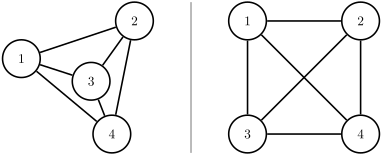
Two isomorphic graphs: just move the vertices around to turn the left graph into the right one. Miriam Briskman, CC BY-NC 4.0.
\documentclass[border=1pt]{standalone}
\usepackage{tikz}

\tikzset{
vertex/.style={draw, circle, very thick, minimum size=1cm},
edge/.style={very thick}
}

\begin{document}

\begin{tikzpicture}

% First graph
\node[vertex] (v1) at (0,0) {$1$};
\node[vertex] (v2) at (3,1) {$2$};
\node[vertex] (v3) at (1.85,-0.6) {$3$};
\node[vertex] (v4) at (2.4,-2) {$4$};

\draw[edge] (v1) -- (v2);
\draw[edge] (v1) -- (v3);
\draw[edge] (v2) -- (v3);
\draw[edge] (v2) -- (v4);
\draw[edge] (v1) -- (v4);
\draw[edge] (v3) -- (v4);

\draw (4.5, 1.5) -- (4.5, -2.5);

% Second graph
\node[vertex] (v5) at (6,1) {$1$};
\node[vertex] (v6) at (9,1) {$2$};
\node[vertex] (v7) at (6,-2) {$3$};
\node[vertex] (v8) at (9,-2) {$4$};

\draw[edge] (v5) -- (v6);
\draw[edge] (v5) -- (v7);
\draw[edge] (v6) -- (v7);
\draw[edge] (v6) -- (v8);
\draw[edge] (v5) -- (v8);
\draw[edge] (v7) -- (v8);

\end{tikzpicture}

\end{document}
 These notes by Miriam Briskman are licensed under CC BY-NC 4.0 and based on sources.