Relation Properties via Digraphs
Since, as we learned, relations can be depicted using diagraphs (or graphs,) we can find what properties (reflexive, anti-reflexive, symmetric, anti-symmetric, and transitive) a relation has by looking at its digraph.
- Definition. [Reflexive relations] A relation $R$ on a set $S$ is called reflexive if, for every $x \in S$, the pair $(x, x)$ is in $R$.
Correspondingly, if every vertex in the digraph $D$ of relation $R$ has a self-loop, then $R$ is reflexive.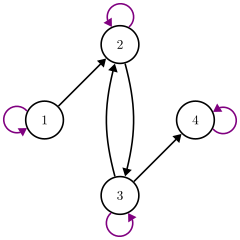
A digraph with vertices each having a self-loop: reflexive. Miriam Briskman, CC BY-NC 4.0.
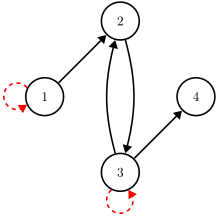
A digraph with at least one vertex without a self-loop: not reflexive. Miriam Briskman, CC BY-NC 4.0.
 These notes by Miriam Briskman are licensed under CC BY-NC 4.0 and based on sources.